


NCT Cancer Registry
The role of NCT Cancer Registry to document clinical occurring data in regard of a tumor patient started in Heidelberg in 2007 with the achievement of completeness of all cancer cases since 2008. In the light of digitalization and continuous development of medical knowledge and methods tumor documentation gained in complexity. The NCT Cancer Registry is responsible to document each cancer case within the NCT, whether being a primary patient, a patient with recurrent disease to be treated in an advanced stage and even a patient demanding a second opinion. Medical tumor documentation includes diagnosis and therapy information as well as staging information and information about the course of the disease. Approximately 13.000-14.000 new cancer patients are registered annually. Of these, about 30 percent are demands on second opinion, with tendency to rise.
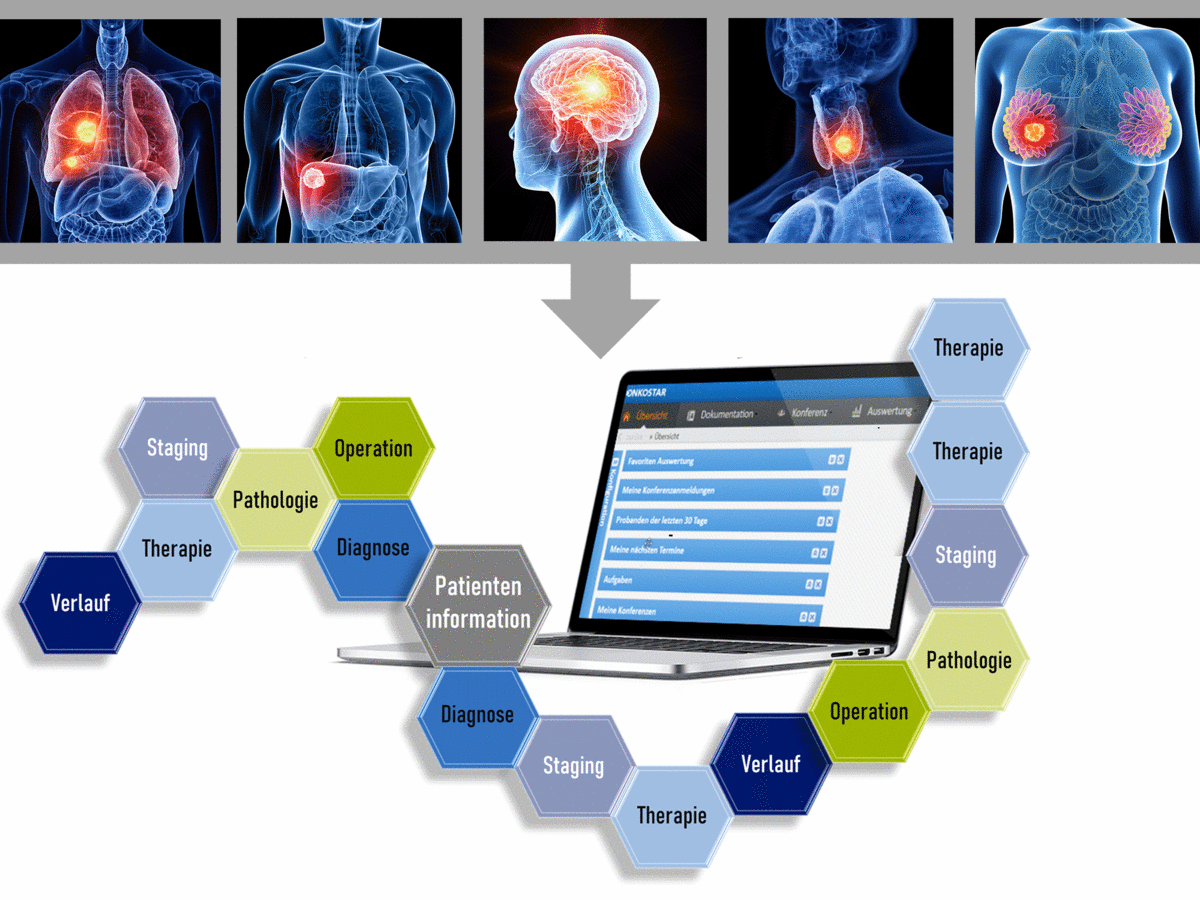
Demographic change is a perceptible factor of the last decades also apparent from annually increasing amounts of newly recorded tumor patients. The combination of massive loads of data and rapid scientific progress in the medical field (e.g. new developed standard techniques such as molecular diagnosis or immunohistochemistry) which are already daily routine have the desired effect to recognize the malignancy and head-on appropriate therapy. Standardized patient-centered medical care is closer than ever.
A prerequisite to use this big load of medical data for quick usage in the clinics and further research is, however, the obligation for the uniform application of medical documentation. As NCT Cancer Registry, we are working on a way to unify medical cancer documentation and thereby hosting state-of-the-art documentation of all cancer patients for upcoming new therapies and better patient care. By creating the standardized medical tumor documentation system (tumor documentation software Onkostar by IT-Choice, Karlsruhe), the NCT Cancer Registry focusses on bringing big data into line for optimizing evaluation and quality control. The focus lies on the well-arranged documentation of the step-by-step therapy progress including all examinations and follow-up therapies carried out after patient diagnosis.
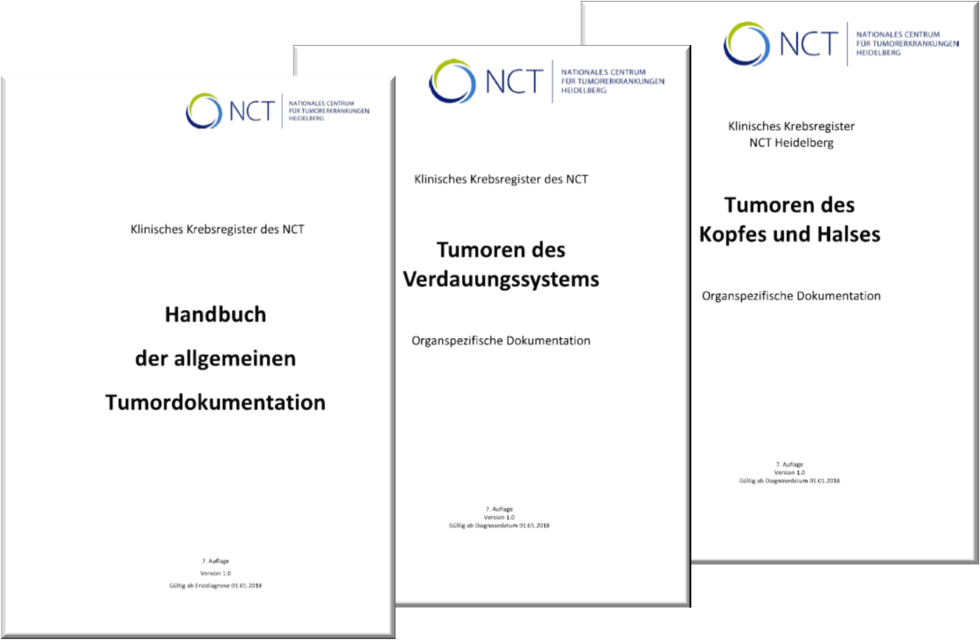
In order to be able to compare and evaluate the data from the NCT cancer registry, they are encrypted according to national and international regulations. This set of rules has been compiled in entity-specific manuals, giving insight into the way the data collection is stored. Furthermore, they contain recommendations for encryption, rules for documentation and tumor classifications for specific organs, anatomically confined organ areas and organ systems:
- code ICD-O-3 histology according to current WHO classification
- ICD-O-3-localization
- ICD-10-diagnosis
- regional lymph nodes
- metastases
- multiple tumors
- tumor-specific staging
- classification
- etc.
The NCT clinical cancer registry - as an important interdisciplinary entity - pursues several objectives:
1. Obligation of the periodical reporting of all tumor diseases (C and certain D diagnoses) to the Landeskrebsregister Baden-Württemberg, which is mandatory since 2009

Data provision and analysis of registration data in an appropriate format and, on agreement, also as targeted, sophisticated analysis:
- for transnational research projects
- for clinical/epidemiological research projects
- for internal quality assurance
- for the prioritization of future NCT work
3. The clinical cancer registry serves as the basis for reports for funding institutions, e.g. Deutsche Krebshilfe, and certifying bodies
4. Certification of oncological centers at the NCT (e.g. detailed documentation and key data extraction) and quality assurance of oncologic treatment is supported by the NCT cancer registry
5. the registry also conducts independent clinical/epidemiological research- and method-oriented development projects
6. Training Services for medical documentalists
Projects
Head: Dr. rer. nat. Antje Brockschmidt
Research Associate: Dr. rer. nat. Beate Köper
The following content is adopted from www.pm4onco.com.
PM4Onco aims at building an alliance between the German Medical Informatics Initiative (MII), the leading oncological centers and consortia, the clinical cancer registries, junior researchers, patients and public to enforce Personalized Medicine (PM) in cancer therapy. One major challenge facing PM and Molecular Tumor Boards (MTBs) is providing, consolidating, and analyzing complex clinical and molecular genetic data. In this context, establishing uniform data standards is critical to enable an efficient collection, use, storage and transfer of data, even between different systems and institutions.
PM4Onco was established to address these challenges, to foster collaboration between existing initiatives and networks and to create an infrastructure that enables efficient use of clinical and basic research data to improve and advance personalized oncology. Another important aspect for PM is each patient's unique disease progression. In AP 1, we are involved in the use of data from cancer registries, which plays a crucial role as in oncology, this provides a comprehensive insight into the course of an individual patient's cancer. Tracking disease progression over time allows detailed follow-up information on patients under therapy or after its completion and is particularly important for detecting relapses, monitoring long-term effects, and analyzing long-term survival rates. This not only enhances research and development of new therapeutic approaches, but also contributes to the continuous improvement of oncology care. For this reason, PM4Onco works together with the Plattform § 65c, an expert committee that ensures a permanent professional exchange of the clinical cancer registries according to § 65c SGB V, in order to use and integrate the data of the clinical cancer registries. In the context of Personalized Oncology, Patient Reported Outcomes (PROs) also play a crucial role. PROs refer to additional data that is generated through individual feedback from patients in the context of pre- or post-hospitalization surveys. This is particularly important concerning information about side effects of the therapy, the occurrence of symptoms or general quality of life and satisfaction. PROs serve as important parameters for evaluating treatment success from the patient's perspective, quality of life and well-being can be considered as additional endpoints in clinical trials and therapy evaluations. For this reason, PM4Onco will focus on ways to digitally implement and capture this data in order to make it effectively accessible for care and research.
Contact person NCT Cancer Registry: Dr. rer. nat. Antje Brockschmidt
Research Associate: B. Sc. Sophia Schäfer
The Hopp Children's Cancer Center Heidelberg (KiTZ) is a joint institution of the German Cancer Research Center (DKFZ), the Heidelberg University Hospital (UKHD) and the Heidelberg University (UniHD). It is a unique institution that enables the research results of childhood tumors in Heidelberg to be implemented more quickly and more effectively in precise therapies.
To better supply patients with oncological and hematological diseases, the Society of Paediatric Oncology and Haematology (GPOH) created platforms to collect data on the disease itself, potential treatment options, as well as complications, and provides it for scientific analysis.
ZIPO registry is hosted by NCTR cancer registry.
» KiTZ Clinical Trial Unit
Contact person: Dr. rer. nat. Antje Brockschmidt
Research Associate: B. Sc. Sophia Schäfer
Registry of Liver Cancer Heidelberg is hostet by NCT cancer registry.
» LCCH – Liver Cancer Center Heidelberg
Contact person: Dr. rer. nat. Antje Brockschmidt
Research Associate: B. Sc. Sophia Schäfer
ZPM registry is hosted by the NCT cancer registry.
Collaborations
- MIRO – Medizinische Informatik in der Radioonkologie Heidelberg
- IT-Choice Software GmbH
- LKR – Landeskrebsregister Baden-Württemberg
- ATO – Arbeitsgemeinschaft der Transdisziplinären Onkologischen Versorgung (ATO)
- CCC Netzwerk – Netzwerk der onkologischen Spitzenzentren der Deutschen Krebshilfe
- ADT – Arbeitsgemeinschaft Deutscher Tumorzentren e.V.
- DVMD – Fachverband für Dokumentation und Informationsmanagement in der Medizin
- DKR – Deutsche Krebsregister e.V. (ehemals GEKID)