

Molecular analyses could improve treatment options for a rare soft tissue tumor
Desmoplastic small- and round-cell tumor is rare, aggressive, and difficult to treat. Researchers at the National Center for Tumor Diseases (NCT) Heidelberg and the German Cancer Research Center (DKFZ) have comprehensively analyzed 30 tumors and identified potential personalized treatment options for nearly all patients. In some patients, new targeted approaches were able to halt the disease for a surprisingly long time.
The National Center for Tumor Diseases (NCT) Heidelberg is a joint institution of the German Cancer Research Center (DKFZ), the Heidelberg University Hospital (UKHD), the Heidelberg Medical Faculty of the Heidelberg University and the Thoraxklinik Heidelberg.
Desmoplastic small and round cell tumor (DSRCT) is a very rare, aggressive soft tissue tumor that primarily affects young men. Because it is so rare, it is very difficult to conduct clinical trials for this type of cancer. Treatment options are correspondingly limited. This problem is exacerbated by the fact that cancer cells in DSRCT usually exhibit only a few genetic alterations. On the one hand, this reduces the likelihood that the tumors will respond to standard immunotherapies. On the other hand, it means that only a small number of patients have tumors with classic genetic alterations that are responsive to targeted therapies. Furthermore, diagnosis is challenging, so DSRCT is often initially misclassified as other types of cancer. The prognosis for patients with the disease is poor: most patients die within three years of diagnosis.
To improve treatment options, researchers at NCT Heidelberg and the DKFZ conducted a comprehensive molecular analysis of 30 patients with DSRCT who participated in the DKFZ/NCT/DKTK MASTER program. The broad molecular analysis made it possible to recommend at least one therapy tailored to their disease for 28 of the 30 participants, which was also implemented in 13 of them. Importantly, data on the response to the individually recommended therapies were also collected and evaluated.
It is noteworthy that the researchers were frequently able to detect proteins in the tumor tissue that can be targeted by novel, targeted therapies, particularly antibody-drug conjugates (ADCs) or therapeutic immune cells, known as CAR-T cells. Using a latest-generation ADC, trastuzumab deruxtecan, unusually long-lasting tumor control was achieved in two patients, in one case for over two years. Additionally, the study found that in eight out of 30 cases, the tumors could only be correctly diagnosed through molecular analysis.
Małgorzata Oleś, a bioinformatician in the Computational Oncology Group at NCT Heidelberg, is one of the study’s first authors. She says: “Our work underscores the potential of broad molecular diagnostics to identify recurring treatment targets, especially for patients with rare tumor types.”
Stefan Fröhling, Executive Director at NCT Heidelberg and Head of the Department of Translational Medical Oncology at the DKFZ, adds: “Progress in this type of cancer is particularly important because those affected are often very young, and we urgently need better treatment options to offer them.”
The study also shows that broad international collaboration between institutions, particularly for rare tumors, is important and can provide valuable insights for the benefit of patients. As part of this study, two of the particularly successful treatments were carried out at the Centre Hospitalier de Luxembourg. Stefan Fröhling says: “We are seeing that our collaboration and sustainable strategic partnership with other centers in Germany and beyond are particularly important for creating new treatment options for patients with rare cancers.”
Publication:
Marcus Renner, Małgorzata Oleś, Nagarajan Paramasivam, Christoph E. Heilig, Annika Schneider, Caroline Modugno, Catherine Herremans, Jennifer Hüllein, Barbara Hutter, Cihan Erkut, Andreas Mock, Eva Krieghoff-Henning, Cecilia B. Jensen, Amirhossein Sakhteman, Matthew The, Tony Prinz, Panna Lajer, Annika Baude-Müller, Katja Beck, Bettina Beuthien-Baumann, Leonidas Apostolidis, Sebastian Bauer, Melanie Boerries, Christian H. Brandts, Damian T. Rieke, Thomas Kindler, Frederick Klauschen, Klaus Schulze-Osthoff, Richard F. Schlenk, Guy Berchem, Michael Allgäuer, Gunhild Mechtersheimer, Albrecht Stenzinger, Daniel B. Lipka, Matthias Schlesner, Bernhard Kuster, Arne Jahn, Evelin Schröck, Christoph Heining, Maria-Veronica Teleanu, Peter Horak, Simon Kreutzfeldt, Daniel Hübschmann, Wolfgang Hartmann, Hanno Glimm, Stefan Fröhling: Multi-Layered Molecular Profiling Informs the Diagnosis and Targeted Therapy of Desmoplastic Small Round Cell Tumor; Nature Communications, https://doi.org/10.1038/s41467-026-71636-0
Image description:
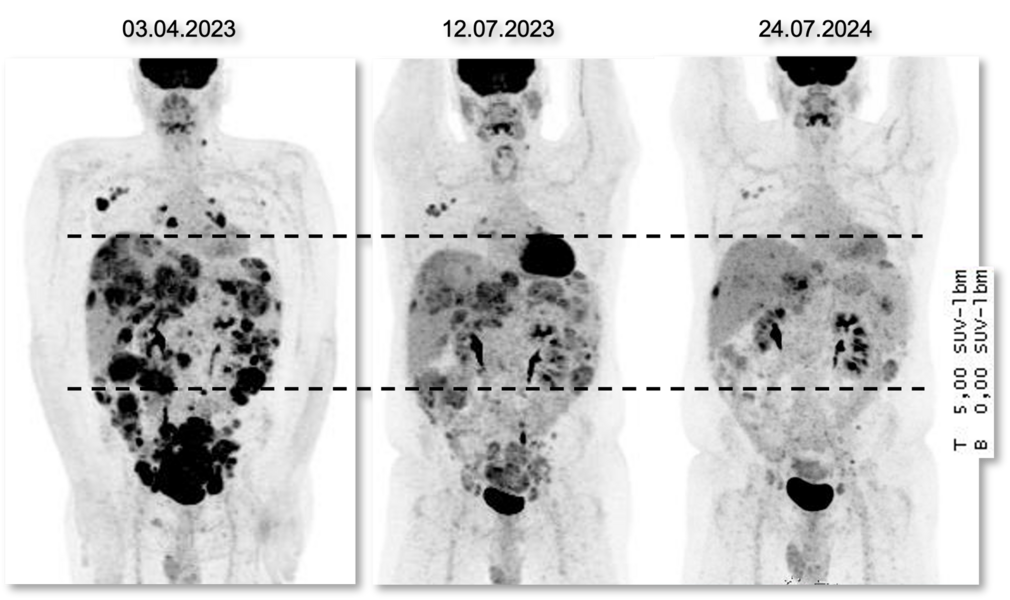
PET (positron emission tomography) scans of a patient taken at three different time points show a very good response to the ADC Trastuzumab deruxtecan, which lasted for approximately 18 months.
Press contact:
Dr. Martin Staiger
National Center for Tumor Diseases (NCT) Heidelberg
Head of Communications and Events
Im Neuenheimer Feld 460
69120 Heidelberg, Germany
Tel.: +49 6221 56-311272
Email: martin.staiger(at)nct-heidelberg.de
www.nct-heidelberg.de
The National Center for Tumor Diseases (NCT) Heidelberg
The National Center for Tumor Diseases (NCT) Heidelberg is a joint institution of the German Cancer Research Center (DKFZ), the University Hospital Heidelberg (UKHD), the Heidelberg Medical Faculty of the Heidelberg University and the Thoraxklinik Heidelberg. The aim of the NCT Heidelberg is to transfer promising approaches from cancer research into clinical practice as quickly as possible, and thus to benefit patients. This applies to both diagnosis and treatment, in aftercare or prevention. Participation in clinical studies opens up access to innovative therapies. The NCT Heidelberg is thus a leader in transferring new research results from the laboratory to the clinic The NCT Heidelberg, founded in 2004, is part of the NCT with further locations in Berlin, Dresden, SouthWest (Tübingen-Stuttgart/Ulm), WERA (Würzburg, Erlangen, Regensburg, Augsburg) and West (Essen/Cologne).
German Cancer Research Center (DKFZ)
With more than 3,000 employees, the German Cancer Research Center (Deutsches Krebsforschungszentrum, DKFZ) is Germany’s largest biomedical research institute. DKFZ scientists identify cancer risk factors, investigate how cancer progresses and develop new cancer prevention strategies. They are also developing new methods to diagnose tumors more precisely and treat cancer patients more successfully. The DKFZ's Cancer Information Service (KID) provides patients, interested citizens and experts with individual answers to questions relating to cancer.
To transfer promising approaches from cancer research to the clinic and thus improve the prognosis of cancer patients, the DKFZ cooperates with excellent research institutions and university hospitals throughout Germany:
- National Center for Tumor Diseases (NCT, 6 sites)
- German Cancer Consortium (DKTK, 8 sites)
- Hopp Children's Cancer Center (KiTZ) Heidelberg
- Helmholtz Institute for Translational Oncology (HI-TRON Mainz) - A Helmholtz Institute of the DKFZ
- DKFZ-Hector Cancer Institute at the University Medical Center Mannheim
- National Cancer Prevention Center (jointly with German Cancer Aid)
The DKFZ is 90 percent financed by the Federal Ministry of Research, Technology and Space and 10 percent by the state of Baden-Württemberg. The DKFZ is a member of the Helmholtz Association of German Research Centers.
Heidelberg University Hospital and Faculty of Medicine: Internationally Renowned Patient Care, Research and Teaching
Heidelberg University Hospital (Universitätsklinikum Heidelberg, UKHD) is one of the largest and most prestigious medical centers in Germany. The Medical Faculty of Heidelberg University (Medizinische Fakultät Heidelberg, MFHD) belongs to the internationally renowned biomedical research institutions in Europe. Both institutions have the common goal of developing new therapies and implementing them rapidly for patients. Heidelberg University Hospital and the Medical Faculty of Heidelberg University employs around 14.500 employees and is committed to providing trainings and qualifications. Every year, around 86,000 patients and more than 1.100.000 outpatient cases are treated in more than 50 clinical departments with almost 2.500 beds.
Together with the German Cancer Research Center (Deutsches Krebsforschungszentrum, DKFZ) and the German Cancer Aid, the UKHD established the first National Center for Tumor Diseases (NCT) in Heidelberg. The goal is to provide care at the highest level as an oncology center of excellence and to rapidly transfer promising approaches from cancer research to the hospital. In addition, the UKHD operates in partnership with the DKFZ and the University of Heidelberg the Hopp Children’s Cancer center Heidelberg (KiTZ), a unique and nationally known therapy and research center for oncological and hematological diseases in children and adolescents.
The Heidelberg Curriculum Medicinale (HeiCuMed) is one of the top medical training programs in Germany. Currently, there are about 4.000 future physicians studying in Heidelberg.