

from23.04.2026
Translating innovative ideas into Research: New Fellows at NCT Heidelberg
The Clinical Translational Research Fellowship at NCT Heidelberg is designed for junior clinicians and medical scientists with innovative study ideas, offering them protected time to further develop their own study concepts.
Throughout the fellowship, participants refine their ideas with structured guidance, expert feedback, and dedicated seminars on key topics such as patient involvement. At the same time, they benefit from interdisciplinary exchange and new perspectives.
By empowering the next generation of clinician and medical scientists, the fellowship aims to translate promising ideas into impactful clinical trials – and ultimately improve patient care.
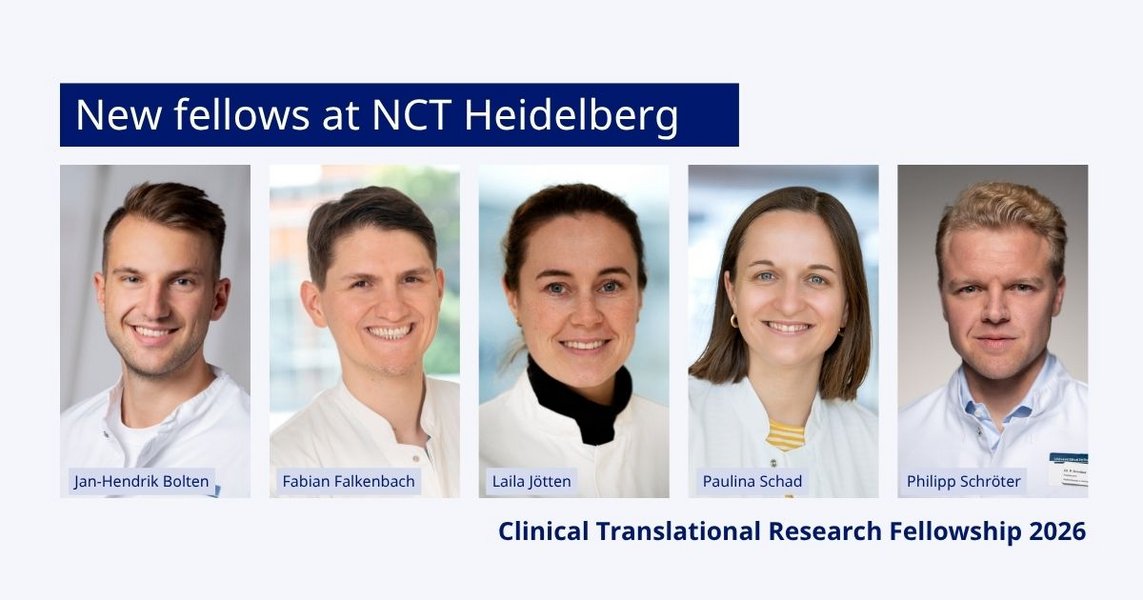
The new cohort of fellows brings together diverse perspectives from radiation oncology, immuno-oncology, urology, and visceral surgery.
Portraits of the five fellows
Jan-Hendrik Bolten: More precise radiation therapy in fewer sessions
Jan-Hendrik Bolten, Department of Radiation Oncology, University Hospital Heidelberg (UKHD), is working on new radiation treatment concepts for locally confined prostate cancer. The goal of his “ENDLESS SMILE” project is to further develop ultra-hypofractionated therapies – that is, treatments with very few, but higher-dose sessions – to significantly shorten the duration of therapy. Until now, such approaches have typically required the implantation of gold markers into the prostate. In the future, these markers may no longer be necessary due to the use of daily-adjusted radiation therapy on a linear accelerator with integrated MRI (magnetic resonance imaging). The highly detailed MRI images allow radiation to be precisely tailored to the individual anatomy, which is expected to reduce side effects and improve patient comfort.
Jan-Hendrik Bolten hopes that the fellowship will allow him to finalize the study concept and gain new insights for clinical implementation through interdisciplinary exchange. He says: “In my view, the most innovative and, at the same time, clinically relevant solutions emerge where different professional perspectives come together.”
Fabian Falkenbach: Improving the patient experience during prostate biopsy
Fabian Falkenbach, Department of Urology, UKHD, is dedicated to improving the patient experience during prostate biopsy. The procedure is central to diagnosis but is often perceived as stressful. In the planned PEACE-PB study, he is investigating whether a complementary mind-body intervention—such as targeted preparation, breathing, and relaxation techniques—can reduce pain and anxiety during the procedure. This will be investigated during transperineal prostate biopsies under local anesthesia by systematically recording how patients perceive the procedure. The goal of the study is to make the procedure more tolerable for patients and thereby also increase acceptance of early detection and active surveillance. With his project, Fabian Falkenbach aims to develop an approach that can be easily integrated into everyday clinical practice.
With the fellowship, which he will undertake at the Clinical Epidemiology of Early Cancer Detection at the German Cancer Research Center (DKFZ), he aims to lay the groundwork for a successful study and further develop his skills as a clinical trialist. At the same time, he emphasizes: “Research—and life, too—is always a team effort; without my wife’s support, much of this would not be possible.”
Laila Jötten: The microbiome as a starting point for new therapies for pancreatic cancer
Laila Jötten, Department of General, Visceral and Transplant Surgery, UKHD, is investigating the influence of the tumor microbiome on treatment outcomes in pancreatic cancer. For this type of cancer, surgery is often the only chance for a cure. A key factor is how well the disease responds to prior therapy. Preclinical and early clinical data suggest that certain bacteria may impair the effectiveness of chemotherapy, while antibiotic therapies could improve response. Her project aims to systematically analyze these relationships and better understand their clinical relevance.
As part of the fellowship, Laila Jötten plans to conduct a multicenter study with a translational approach that also incorporates molecular analyses. In the long term, the goal is to determine whether the microbiome can be used as a therapeutic target. With the fellowship, she particularly hopes to advance the complex study planning. She says: “I am especially excited about the further development of cancer therapies and the wide range of possibilities for making this a reality.”
Paulina Schad: Making immunotherapies more effective in children
Paulina Schad, Department of Pediatric Oncology, Hematology, and Immunology, UKHD and Hopp Children’s Cancer Center Heidelberg, is working on a new therapeutic approach for children with cancer. The focus is on a fusion protein that specifically targets the tumor microenvironment and is intended to improve the efficacy of modern immunotherapies such as CAR-T cells. The rationale is that not all patients respond equally well to these therapies.
The project aims to create the conditions for a better response to immunotherapies and make their use possible for more patients. During her fellowship, Paulina Schad is conducting a comprehensive evaluation on the safety and tolerability of the new approach to lay the groundwork for sharpening the clinical trial design.
She says: “The fellowship provides the necessary protected environment to develop a well-founded and structured study design.” At the same time, she aims to further develop her skills in independent study planning and benefit from interdisciplinary exchange.
Philipp Schröter: Tailoring Radiation Therapy for Head and Neck Tumors
Philipp Schröter, Department of Radiation Oncology, UKHD, focuses on the treatment of head and neck cancers and the question of how radiation therapy can be more precisely tailored to individual patients. At the centre of his work is whether radiation volumes in the neck can be safely reduced — minimizing side effects such as swallowing difficulties, dry mouth and suppression of the immune system — without compromising cancer control.
Radiation therapy for head and neck cancers often covers large areas. As treatment increasingly incorporates immunotherapy alongside surgery and radiation, a compelling question emerges: could radiation volumes be more precisely adapted to healthy tissue and lymphatic structures, better cooperating with the immune responses that modern combination treatments rely on? Philipp Schröter investigates this through clinical outcome analyses and translational studies tracking patients' immune responses during and after treatment.
The program enables him to translate this work into a prospective clinical trial, advancing evidence-based and patient-centred adaptation of radiotherapy in multimodal head and neck cancer treatment. He says: "Many relevant questions arise directly from patient care and can only be meaningfully addressed through an interdisciplinary approach."
Further News
Daraxonrasib for Pancreatic Cancer: Experts and Study Participants from the NCT Heidelberg in the Media
CCE Summer School 2026: New Impulses for Tomorrow’s Cancer Research