

Knowledge Connector: better clinical decisions in molecular precision oncology
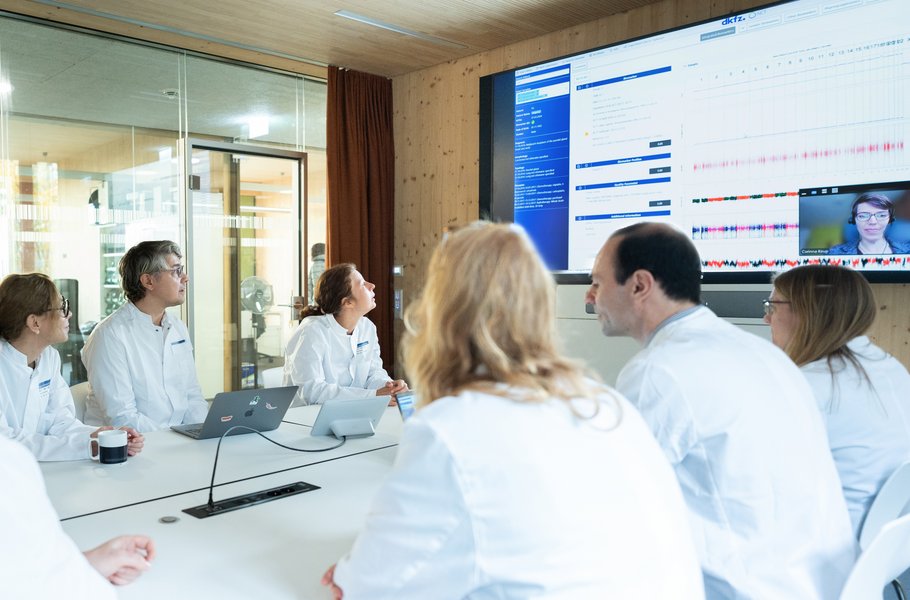
Researchers at the National Center for Tumor Diseases (NCT) Heidelberg and the German Cancer Research Center (DKFZ) have developed a digital tool that significantly accelerates and improves clinical decisions in molecular precision oncology. The Knowledge Connector enables the structured and standardized evaluation of very extensive molecular tumor profiles and makes them available for personalized therapy decisions faster than before. Developed in the DKFZ/NCT/DKTK MASTER program, the Knowledge Connector has been in use at several NCT locations and other leading oncology centers since 2022.
The National Center for Tumor Diseases (NCT) Heidelberg is a joint institution of the German Cancer Research Center (DKFZ), Heidelberg University Hospital (UKHD), Heidelberg University Medical Faculty, and Thoraxklinik Heidelberg.
The increasingly rapid and comprehensive molecular diagnostics based on “omics” data are creating a previously unknown level of detail in the characterization of tumors. The artificial word “omics” refers to the analysis of complex biological data sets, such as DNA, RNA, or proteins. The resulting very large amounts of data open up the possibility of additional individualized treatment approaches for patients.
At the same time, the enormous amounts of data pose a challenge for practitioners: they exceed the capacity of conventional evaluations and lead to a bottleneck in clinical decision-making. This is precisely where the Knowledge Connector comes in as a powerful IT solution for visualization and decision support in molecular precision oncology. It bundles and aggregates information, integrates current global expertise, and supports evidence-based analyses by molecular tumor boards.
Peter Horak, Department of Translational Medical Oncology at DKFZ and NCT Heidelberg, is one of the senior authors of the study. He says: “The Knowledge Connector allows us to quickly and reliably translate complex molecular profiles of patients into clinical treatment recommendations. This saves us crucial time in offering individually tailored therapies.”
An interdisciplinary team developed the Knowledge Connector in the DKFZ/NCT/DKTK MASTER program. Specialists from molecular precision oncology, clinical care, bioinformatics, and IT were involved. The result is a digital tool that provides the relevant findings from the omics data sets in a compact, clear display.
The Knowledge Connector benefits from an active specialist community: they contribute their knowledge, while at the same time utilizing the constantly growing knowledge base, thus driving a cycle. This makes the system better and better and increases its acceptance among users. Lead author Daniel Hübschmann, head of the Computational Oncology working group at DKFZ and NCT Heidelberg, says: “From a bioinformatics perspective, the Knowledge Connector stands out because it not only integrates large amounts of data, but also structures, standardizes, and prepares it for reuse. With each case processed, our knowledge base grows and continues to gain value.”
The Knowledge Connector has been in use since 2022 – starting at NCT Heidelberg and now also at the NCT locations in Dresden, Berlin, and WERA (Augsburg). The application is also being tested at the Comprehensive Cancer Center Hamburg. To date, more than 2,000 patient cases have been processed by the Knowledge Connector in the molecular tumor board.
Stefan Fröhling, Head of the Department of Translational Medical Oncology at the DKFZ and Managing Director at NCT Heidelberg, says: “With the Knowledge Connector, we have developed a tool that combines molecular diagnostics with IT solutions to create a powerful clinical decision-making aid. Its development was only possible thanks to a great deal of personal commitment and a joint effort.” Following its successful launch, the team behind the Knowledge Connector aims to consolidate its further development with new staff and roll out the system throughout the NCT and the German Consortium for Translational Cancer Research (DKTK).
Publication:
Daniel Hübschmann, Simon Kreutzfeldt, Benjamin Roth, Katrin Glocker, Janine Schoop, Lena Oeser, Steffen Hausmann, Christian Koch, Sebastian Uhrig, Jennifer Hüllein, Barbara Hutter, Martina Fröhlich, Christoph E. Heilig, Maria-Veronica Teleanu, Daniel B. Lipka, Irina A. Kerle, Annika Baude, Katja Beck, Christoph Heining, Hanno Glimm, Frank Ückert, Alexander Knurr, Stefan Fröhling, Peter Horak. Knowledge Connector: Decision support system for multiomics-based precision oncology. Nature Communications; doi.org/10.1038/s41467-026-68333-3
An image accompanying this press release is available free of charge at:
https://www.nct-heidelberg.de/fileadmin/media/nct-heidelberg/news/pressemitteilungen/Knowledge_Connector_NCT_Heidelberg.jpg
Terms of use for images accompanying press releases
Use is free of charge. The NCT Heidelberg permits one-time use in connection with reporting on the topic of the press release. Please cite the copyright “NCT Heidelberg/Marius Stark” as the image credit. The image material may only be passed on to third parties after prior consultation with NCT Communications (tel.: +49 6221 42-56311272, email: martin.staiger@nct-heidelberg.de). Use for commercial purposes is prohibited.
Press contact:
Dr. Martin Staiger
National Center for Tumor Diseases (NCT) Heidelberg
Communications and Events
Im Neuenheimer Feld 460
69120 Heidelberg, Germany
Tel.: +49 6221 56-311272
Email: martin.staiger(at)nct-heidelberg.de
www.nct-heidelberg.de
The National Center for Tumor Diseases (NCT) Heidelberg
The National Center for Tumor Diseases (NCT) Heidelberg is a joint institution of the German Cancer Research Center (DKFZ), the University Hospital Heidelberg (UKHD), the Heidelberg Medical Faculty of the Heidelberg University and the Thoraxklinik Heidelberg. The aim of the NCT Heidelberg is to transfer promising approaches from cancer research into clinical practice as quickly as possible, and thus to benefit patients. This applies to both diagnosis and treatment, in aftercare or prevention. Participation in clinical studies opens up access to innovative therapies. The NCT Heidelberg is thus a leader in transferring new research results from the laboratory to the clinic The NCT Heidelberg, founded in 2004, is part of the NCT with further locations in Berlin, Dresden, SouthWest (Tübingen-Stuttgart/Ulm), WERA (Würzburg, Erlangen, Regensburg, Augsburg) and West (Essen/Cologne).
German Cancer Research Center (DKFZ)
With more than 3,000 employees, the German Cancer Research Center (Deutsches Krebsforschungszentrum, DKFZ) is Germany’s largest biomedical research institute. DKFZ scientists identify cancer risk factors, investigate how cancer progresses and develop new cancer prevention strategies. They are also developing new methods to diagnose tumors more precisely and treat cancer patients more successfully. The DKFZ's Cancer Information Service (KID) provides patients, interested citizens and experts with individual answers to questions relating to cancer.
To transfer promising approaches from cancer research to the clinic and thus improve the prognosis of cancer patients, the DKFZ cooperates with excellent research institutions and university hospitals throughout Germany:
- National Center for Tumor Diseases (NCT, 6 sites)
- German Cancer Consortium (DKTK, 8 sites)
- Hopp Children's Cancer Center (KiTZ) Heidelberg
- Helmholtz Institute for Translational Oncology (HI-TRON Mainz) - A Helmholtz Institute of the DKFZ
- DKFZ-Hector Cancer Institute at the University Medical Center Mannheim
- National Cancer Prevention Center (jointly with German Cancer Aid)
The DKFZ is 90 percent financed by the Federal Ministry of Research, Technology and Space and 10 percent by the state of Baden-Württemberg. The DKFZ is a member of the Helmholtz Association of German Research Centers.
Heidelberg University Hospital and Faculty of Medicine: Internationally Renowned Patient Care, Research and Teaching
Heidelberg University Hospital (Universitätsklinikum Heidelberg, UKHD) is one of the largest and most prestigious medical centers in Germany. The Medical Faculty of Heidelberg University (Medizinische Fakultät Heidelberg, MFHD) belongs to the internationally renowned biomedical research institutions in Europe. Both institutions have the common goal of developing new therapies and implementing them rapidly for patients. Heidelberg University Hospital and the Medical Faculty of Heidelberg University employs around 14.500 employees and is committed to providing trainings and qualifications. Every year, around 86,000 patients and more than 1.100.000 outpatient cases are treated in more than 50 clinical departments with almost 2.500 beds.
Together with the German Cancer Research Center (Deutsches Krebsforschungszentrum, DKFZ) and the German Cancer Aid, the UKHD established the first National Center for Tumor Diseases (NCT) in Heidelberg. The goal is to provide care at the highest level as an oncology center of excellence and to rapidly transfer promising approaches from cancer research to the hospital. In addition, the UKHD operates in partnership with the DKFZ and the University of Heidelberg the Hopp Children’s Cancer center Heidelberg (KiTZ), a unique and nationally known therapy and research center for oncological and hematological diseases in children and adolescents.
The Heidelberg Curriculum Medicinale (HeiCuMed) is one of the top medical training programs in Germany. Currently, there are about 4.000 future physicians studying in Heidelberg.