


Creating New Treatment Options: Molecular Profiling of Rare Tumors
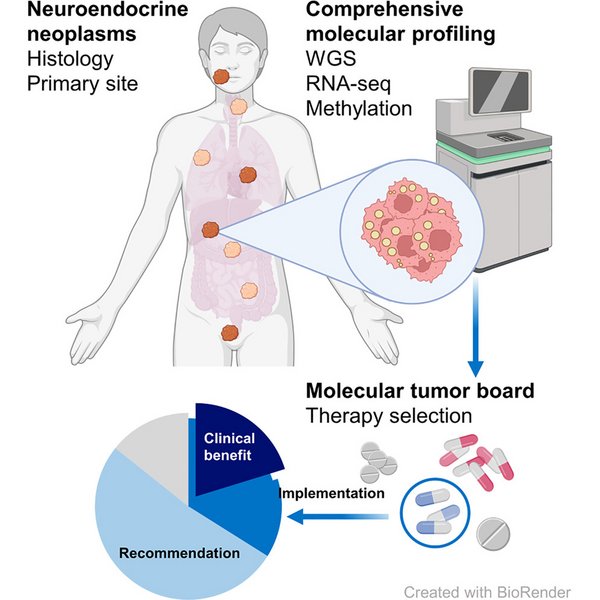
Rare cancers account for 20 to 25 percent of all new cancer diagnoses worldwide, yet patients with these diseases are often faced with limited treatment options. Can comprehensive molecular profiling help address this gap? Researchers at NCT Heidelberg and top-tier collaborative partners investigated this question. Their study, now published in the journal Med by Cell Press, demonstrates how modern molecular diagnostics can open up new treatment options for patients with rare neuroendocrine neoplasms (NENs). NENs are rare tumors that arise from hormone-producing (neuroendocrine) cells and are often not diagnosed until advanced stages.
The analysis is based on data from the MASTER program of the German Cancer Research Center, the NCT sites, and the German Consortium for Translational Cancer Research. Patients who had already undergone several therapies were examined using comprehensive genetic analyses—including whole-genome and exome sequencing, as well as RNA sequencing, which provides information about active genes.
On this basis, individualized treatment recommendations could be derived for approximately 85 percent of the patients. A clinical benefit was observed in about 70 percent of the evaluable cases. This suggests that precise molecular characterization can have concrete implications for treatment even in rare tumors.
The study also provides evidence of specific biological mechanisms that could be exploited therapeutically: For example, treatment with the chemotherapeutic agent temozolomide can lead to defects in DNA repair (mismatch repair deficiency) in some patients. This increases the number of mutations in the tumor, potentially making it more vulnerable to immunotherapies such as checkpoint inhibitors.
In individual cases, rare genetic alterations were also discovered that could be targeted for treatment and were associated with very good therapeutic responses.
The results are part of a series of studies on rare tumor diseases in the MASTER program, which employ differentiated molecular diagnostics to open up new avenues even for patients with limited treatment options.
Publication:
Simon Kreutzfeldt, Leonidas Apostolidis, Małgorzata Oles, Eva Krieghoff-Henning, Christoph E. Heilig, Christoph Heining, Andreas Mock, Maria-Veronica Teleanu, Barbara Hutter, Laura Gieldon, Barbara Klink, Katja Beck, Daniela Richter, Annika Baude-Müller, Eva Reisinger, Nils Hammer, Leila Kamkar, Katrin Pfütze, Christina Geörg, Mario Lamping, Damian T. Rieke, Sebastian Uhrig, Henning Jann, Ulrich-Frank Pape, Michael Allgäuer, Albrecht Stenzinger, Eva C. Winkler, Bertram Wiedenmann, Dirk Jäger, Benedikt Brors, Daniel Hübschmann, Evelin Schröck, Ulrich Keilholz, Marianne Pavel, Peter Horak, Hanno Glimm, and Stefan Fröhling: Clinically actionable genomic and transcriptomic landscape of advanced neuroendocrine neoplasms DOI: 10.1016/j.medj.2026.101130