

Check this out: National Cancer Prevention Week Launches an Information Campaign on Early Cancer Detection
Joint Press Release from German Cancer Aid, the German Cancer Research Center (DKFZ), and the German Cancer Society (DKG)
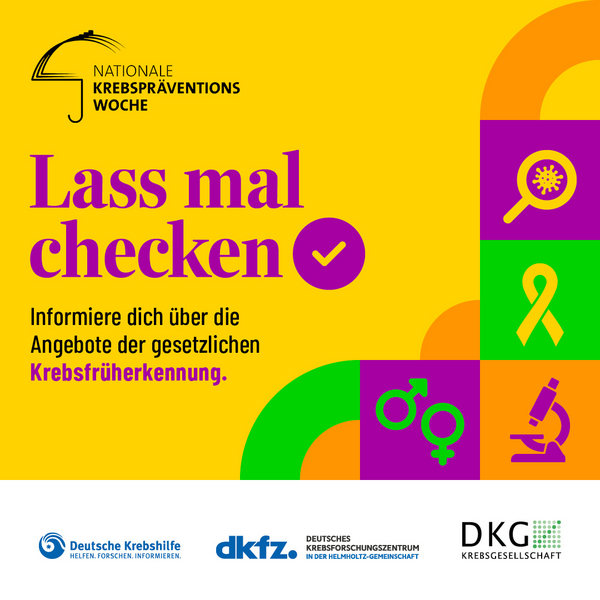
More than 500,000 people in Germany are diagnosed with cancer each year. About one-third of these cases affect people of working age. German Cancer Aid, the German Cancer Research Center, and the German Cancer Society are therefore launching a workplace early detection campaign as part of National Cancer Prevention Week 2026 (September 21–27). Under the slogan “Let’s get checked,” the three organizations are providing information about early cancer detection options and offering companies free informational materials and campaign modules for their employees. In light of the current discussions about budget cuts in the healthcare system, they are also appealing to policymakers not to cut back on early detection and are advocating for a more targeted approach to reaching people so that—once properly informed—they can benefit from the available services.
The Federal Ministry of Research, Technology, and Space (BMFTR) and the Federal Ministry of Health (BMG) support National Cancer Prevention Week and highlight the potential of prevention and early detection. Dorothee Bär, Federal Minister of Research, Technology, and Space: “One in two people will develop cancer at some point in their lives. Early detection and avoiding risk factors are the two most important pillars of cancer prevention. This enables us to ensure that cancer either does not develop in the first place or is detected early enough. As part of the National Decade Against Cancer, there is therefore a special focus on cancer prevention research.”
Dr. Carsten Linnemann, Federal Minister of Health, calls on people to participate in cancer screening exams at the start of Cancer Prevention Week: “Cancer screening can save lives. It helps detect changes early, before symptoms appear, and thus improves the chances of successful treatment. Make sure to keep your screening appointments. Your health is worth it!”
Early Cancer Detection in Germany
People with public health insurance in Germany are entitled to screening exams for breast, colorectal, cervical, skin, and prostate cancer. Heavy smokers can also be screened for lung cancer starting this year.
Detecting Cancer Early – Reducing Cancer Mortality
The earlier a tumor is detected, the better the chances of recovery are, as a general rule. In addition, tumors in the early stages can usually be treated with less invasive methods, which improves quality of life. Early detection can therefore save lives. For example, a recent evaluation of mammography screening shows that participation significantly contributes to reducing breast cancer mortality.
Some early detection screenings can also identify precancerous changes, preventing cancer from developing in the first place. This applies, for example, to cervical cancer screening and colorectal cancer screening via colonoscopy, during which polyps that could later develop into colorectal cancer are often removed. German Cancer Aid, the DKFZ, and the DKG therefore urge people to inform themselves about the benefits and risks of these screenings.
Outlook: Removing Barriers, Reaching Target Groups, and Aiming for Further Development
Despite the benefits of cancer screening, many people with public health insurance do not participate. Only about half of eligible women take advantage of mammography screening, and combined, fewer than 50 percent of those eligible participate in the two colorectal cancer screening programs. The reasons are varied: insufficient or unclear information, fears of negative test results, and long wait times to see specialists. Furthermore, all cancer screening programs primarily reach people with higher levels of education.
Dr. Konstanze Blatt, Secretary General of the DKG, advocates for removing unnecessary barriers: “We need to establish more community-based services and reach people where they spend their time, such as at their workplace. During this year’s Cancer Prevention Week, we are therefore launching an information campaign directly in workplaces to provide working people with easily accessible information,” says Blatt. It’s also worth looking at other EU countries that simplify access to cancer screening: “In the Netherlands, insured individuals automatically receive the immunological stool test for colorectal cancer screening directly at home. There’s also the option to receive the HPV test by mail and perform it yourself. At-home self-tests could also increase participation rates in cancer screening programs here as a supplementary option.”
“The effectiveness of any screening program stands or falls with participation,” says Prof. Dr. Michael Baumann, Chairman of the Board of the DKFZ, adding: “We need to do better in this regard. And we need to reach the right people—not just those who are already health-conscious. We therefore strongly recommend targeting people at particularly high risk more specifically in the future so that they can benefit from these services.”
“In addition to urging people to learn about cancer screening and take advantage of its potential, we must also always keep an eye on improvements and the further development of current screening programs,” says Gerd Nettekoven, CEO of German Cancer Aid. “Future strategies should be based not only on age and gender, but more strongly on an individual’s personal risk.” How many people in Germany have a genetic predisposition to cancer? How does lifestyle influence the risk of developing a tumor? And how can these individual risks be incorporated into the cancer screening programs offered by statutory health insurance to further improve them? “Research into cancer screening must continue, and above all, the programs must be adequately evaluated so that they can be tailored more to individual needs and risk profiles, enabling the detection of more tumors at an early stage in the future. In the long run, this can save lives,” says Nettekoven.
Campaign: “Let’s Get Checked”
To mark National Cancer Prevention Week 2026, September 21–27, the three organizations are using the “Let’s Get Checked” campaign to provide information about legally mandated cancer screening programs and are offering businesses and companies free informational and outreach modules on this topic for their employees: www.krebspraeventionswoche.de
Further Information on Early Detection
Detecting cancer early—but how? Effective screening must reach those who stand to benefit the most, avoid unnecessary diagnostic tests, and achieve the greatest possible impact with limited resources. We interviewed five experts on early detection in Germany: What works, and what do we need to do better? They all agree: a targeted approach rather than a one-size-fits-all approach, organized rather than left to chance, and low-barrier rather than complicated. The interviews are freely available for publication.
Lass mal checken | National Cancer Prevention Week
About National Cancer Prevention Week
National Cancer Prevention Week is a joint initiative of German Cancer Aid, the German Cancer Research Center, and the German Cancer Society. Through this initiative, the three organizations aim to raise awareness of the significant potential of prevention in the fight against cancer. The vision: to prevent cancer from developing in the first place. National Cancer Prevention Week takes place annually in September. Learn more at: www.krebspraeventionswoche.de
Supporting Associations and Participating Companies of NKPW 2026
• Alstom Transportation Germany GmbH
• Amgen GmbH
• AUDI AG
• Bayer AG
• Beiersdorf AG
• BKK Dachverband
• Federal Ministry of Health
• Federal Association for Workplace Health Management e.V.
• German Society for Occupational and Environmental Medicine e.V.
• FUCHS SE
• HORNBACH Baumarkt AG
• ONCOnnect
• Children’s Research Foundation
• Association of German Occupational and Plant Physicians e. V.
• Viessmann Generations Group
Press Contact
German Cancer Society e. V.
Angelina Gromes and Clara Teich
Kuno-Fischer-Straße 8
14057 Berlin
Tel: 030 3229329-60
presse(at)krebsgesellschaft.de
German Cancer Research Center
Dr. Sibylle Kohlstädt
Im Neuenheimer Feld 280
69120 Heidelberg
Tel.: 06221 42-2843
Email: s.kohlstaedt@dkfz.de
German Cancer Aid Foundation
Charlotte Weiß
Buschstr. 32
53113 Bonn
Tel.: 0228 72990-96
Email: presse@krebshilfe.de